Prep & testing · Epoxy & resin floors
How to tell if your concrete slab is dry enough to coat
Most epoxy floors that bubble or peel didn't fail on the surface — they failed from moisture moving up through the slab. Before you coat, there are three standard ways to know if the concrete is ready.
Why slab moisture wrecks a coating
Concrete is porous, and water vapor moves up through it from the ground and from moisture still inside a fresh pour. Seal that surface with epoxy before the slab is dry enough and the vapor has nowhere to go — pressure builds under the film and you get bubbling, blistering, and delamination weeks or months later. It's one of the most common causes of epoxy floor failure, and it has nothing to do with how well you mixed or rolled.
New concrete is the obvious risk (give a fresh pour about 28 days to cure before coating), but even old slabs on grade without a working vapor barrier can push enough moisture to fail a coating.
Test 1 — the plastic sheet test (free, do this at minimum)
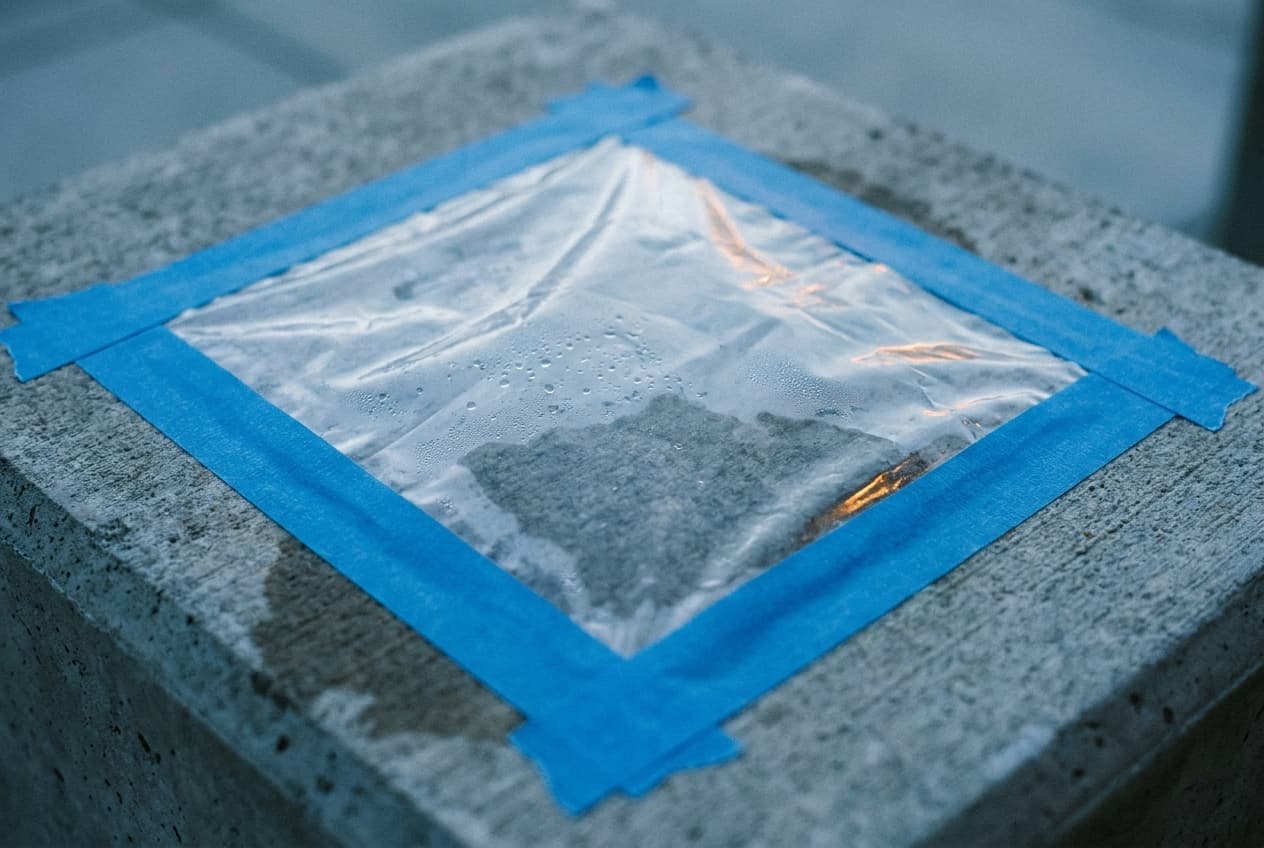
The simplest check (ASTM D4263): tape an 18-inch square of clear plastic sheeting tightly to the slab on all four edges and leave it 16–24 hours. Lift it and look. Condensation under the plastic, or a darkened patch of concrete, means moisture is moving up and the slab isn't ready. It's a pass/fail screen, not a number — but it's free, and it catches the worst slabs.
Tests 2 & 3 — the quantified ones
When you need a real number (and for any commercial job, you do), there are two standards. The calcium chloride test (ASTM F1869) measures the moisture vapor emission rate — pounds per 1,000 sq ft per 24 hours — and most epoxy systems want that under about 3 lbs (check your product). The in-situ relative humidity probe (ASTM F2170) reads the RH inside the slab, with most manufacturers wanting it under roughly 75–85%.
If the slab fails, you either wait and re-test, or use a moisture-mitigation primer / vapor barrier rated for your reading before coating. Don't just hope it dries.
- Let new concrete cure ~28 days before coating
- Plastic sheet test (ASTM D4263) — free pass/fail, do it every time
- Calcium chloride (ASTM F1869) and in-situ RH (ASTM F2170) for a real number
- Failed slab → moisture-mitigation primer, not wishful thinking
Two kinds of moisture — from below and from above
Slab testing handles the moisture coming up from below. But there's a second moisture threat on coating day the tests don't cover: condensation from above, when the slab surface sits within 5°F of the dew point and air moisture settles onto it during the pour and cure. That's what causes amine blush and disrupted surface cure — a clean, dry slab can still be ruined by coating it on the wrong morning.
So a ready floor needs both: a slab that's dry enough (these tests) and conditions that keep the surface above the dew point through the cure. paint-day watches the second half — the free epoxy city pages and monitor flag the temperature and dew-point window — so once your slab passes its moisture test, you can time the pour for a day that won't condense on it.
Common questions
- How do you test if concrete is dry enough for epoxy?
- At minimum, do the plastic sheet test (ASTM D4263): tape an 18-inch square of clear plastic to the slab for 16–24 hours and check for condensation or darkening underneath. For a real number, use a calcium chloride test (ASTM F1869, usually under ~3 lbs/1,000 sq ft/24 hr) or an in-situ RH probe (ASTM F2170, usually under ~75–85%).
- How long should new concrete cure before epoxy?
- Give a fresh concrete pour about 28 days to cure before coating, then still run a moisture test — curing time and dryness aren't the same thing, and slabs on grade without a working vapor barrier can stay wet much longer.
- Can you epoxy over a damp slab?
- No — sealing a damp slab traps moisture vapor under the film, which builds pressure and causes bubbling, blistering and delamination later. If the slab fails a moisture test, either let it dry and re-test or use a moisture-mitigation primer rated for your reading before coating.
- Does the dew point still matter if my slab is dry?
- Yes. Slab tests cover moisture coming up from below, but on coating day condensation can settle from above if the slab surface is within 5°F of the dew point — causing amine blush and a disrupted surface cure. A dry slab still needs to be coated on a day that stays above the dew point through the cure.
Check your week
Live epoxy & resin floors forecasts
See a 7-day go/no-go calendar built from the surface-vs-dew-point rule for your city.
More from the field guide
- Why did my epoxy floor turn cloudy, hazy or greasy?
- Dew point for painting: the rule that prevents most coating failures
- Can you paint when it's humid? Yes — but watch the right number
- Why is my deck stain still tacky and won't dry?
- How long does deck stain need to dry before rain?
- Why is my epoxy floor still soft, tacky or not curing?
Last reviewed 2026-06-30. A scheduling & risk advisory — confirm the surface temperature on-site with an IR thermometer before you coat.