Failure diagnosis · Epoxy & resin floors
Why is my epoxy floor still soft, tacky or not curing?
A floor that's still soft or sticky days after you poured it isn't curing slowly — something stopped the chemistry. There are three causes, and only two of them are recoverable.
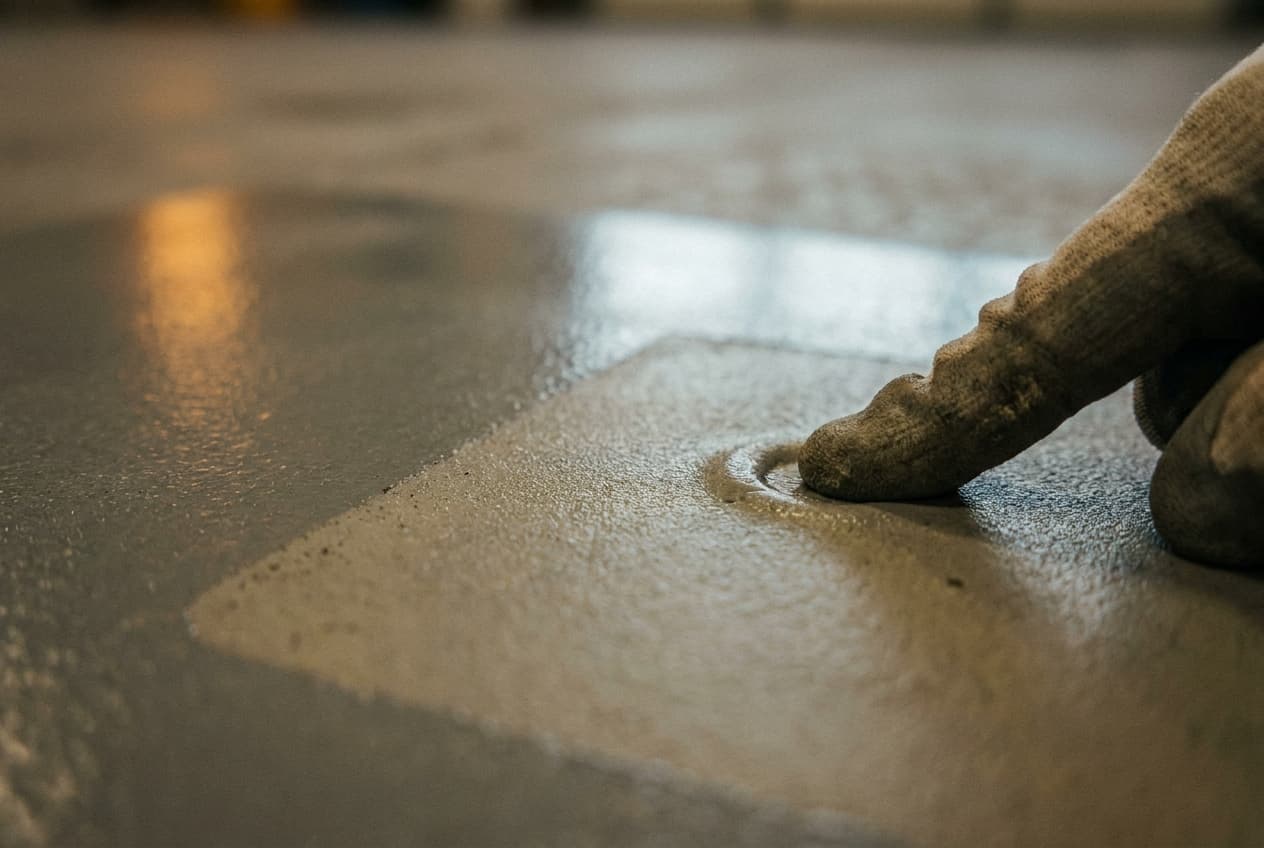
Soft epoxy is not the same as cloudy epoxy
First, sort out which failure you have. A cloudy, greasy, or hazy surface that's otherwise hard is amine blush — a surface reaction with moisture. A floor that stays soft, rubbery, dented by a fingernail, or tacky all the way through is a different problem: the resin and hardener never finished reacting. This page is about the second one.
An under-cured epoxy isn't just ugly — it has no strength or chemical resistance and will gouge, peel and fail. Getting the cause right tells you whether it can be saved.
Cause 1 — the mix was off
The most common reason epoxy never hardens is the mix: the wrong resin-to-hardener ratio, eyeballed instead of measured, or not stirred thoroughly enough (including scraping the sides and bottom of the bucket). Epoxy cures by a fixed chemical reaction — get the ratio wrong or leave unmixed product, and parts of it simply never cure.
An off-ratio or under-mixed floor will not harden with time. There's no fix but to grind it off and start over with carefully measured, fully mixed product.
Cause 2 — it was too cold
Epoxy cure is temperature-driven: as a rule of thumb the cure time roughly doubles for every ~18°F drop, and below each product's minimum (often around 50–60°F) it slows to a crawl or stalls. Critically, it's the slab temperature that governs the reaction, and concrete runs colder than the air and keeps falling overnight — so a floor poured in a cool garage in the afternoon can stall when the slab keeps dropping after dark.
The good news: a cold-stalled epoxy that was mixed correctly will often finish curing if you warm the space back up (steady heat, not a torch) and give it time. Temperature is the recoverable cause.
Cause 3 — moisture during cure
High humidity and a slab sitting near the dew point interfere with the cure as well as causing blush — the surface stays soft or sticky where moisture disrupted the reaction. Moisture coming up through the slab (a slab that wasn't dry enough to coat) can do the same from below and lift the whole floor.
Fixing moisture-affected epoxy depends on severity: a thin, blush-only tacky layer may be washable, but a floor that's soft from moisture interference or slab vapor usually has to come off.
- Measure the ratio and mix thoroughly — off-ratio epoxy never cures (grind & redo)
- Keep the slab in the product's temperature range and not falling overnight
- Coat when the slab holds 5°F above the dew point and humidity is in range
- Make sure the slab is dry enough before you start (moisture from below stalls cure too)
Get the conditions right next time
Two of the three causes — temperature and moisture — are about the conditions through the cure window, not just the moment you pour. Confirm the slab will stay in range and above the dew point for the full cure, and that it's dry enough to coat, before you commit a day.
paint-day watches the temperature and dew-point side of that for you: the free epoxy city pages show a 7-day go/no-go calendar built from the slab-surface-vs-dew-point and temperature rule, and the free monitor emails you when a good coating window opens — or when an overnight cold or condensation risk threatens a floor that's still curing.
Common questions
- Will uncured epoxy eventually harden?
- It depends on the cause. Epoxy that's soft because it was too cold will usually finish curing once you warm the space and give it time. Epoxy that was mixed off-ratio or under-mixed will never harden — it has to be ground off and redone. Moisture-affected floors usually have to come off too.
- What temperature does epoxy need to cure?
- Most epoxies want the slab and air in roughly the 50–86°F range, and cure time roughly doubles for every ~18°F drop. Below the product's minimum the cure stalls. Because concrete runs colder than the air and keeps cooling overnight, it's the slab temperature through the whole cure window that matters, not just the afternoon air.
- Why is my epoxy floor soft but not cloudy?
- A soft, rubbery or tacky-throughout floor means the resin and hardener didn't fully react — usually an off-ratio or under-mixed batch, or a cure that was too cold. (A cloudy or greasy surface that's otherwise hard is amine blush, a separate moisture-driven surface problem.)
- How long should epoxy take to cure?
- Epoxy is typically walk-on hard in about 24 hours and fully cured in several days, but that assumes the right temperature. In a cool space the cure can take far longer or stall entirely. Keep the slab in range and above the dew point through the whole window.
Check your week
Live epoxy & resin floors forecasts
See a 7-day go/no-go calendar built from the surface-vs-dew-point rule for your city.
More from the field guide
- Why did my epoxy floor turn cloudy, hazy or greasy?
- Dew point for painting: the rule that prevents most coating failures
- Can you paint when it's humid? Yes — but watch the right number
- Why is my deck stain still tacky and won't dry?
- How long does deck stain need to dry before rain?
- How to tell if your concrete slab is dry enough to coat
Last reviewed 2026-06-30. A scheduling & risk advisory — confirm the surface temperature on-site with an IR thermometer before you coat.