Failure diagnosis · Epoxy
Why did my epoxy floor turn cloudy, hazy or greasy?
If your fresh epoxy or polyaspartic floor cured to a cloudy film, a greasy haze, or a sticky bloom, you are almost certainly looking at amine blush — and it traces back to one number nobody checked.
The short answer: it's amine blush (carbamation)
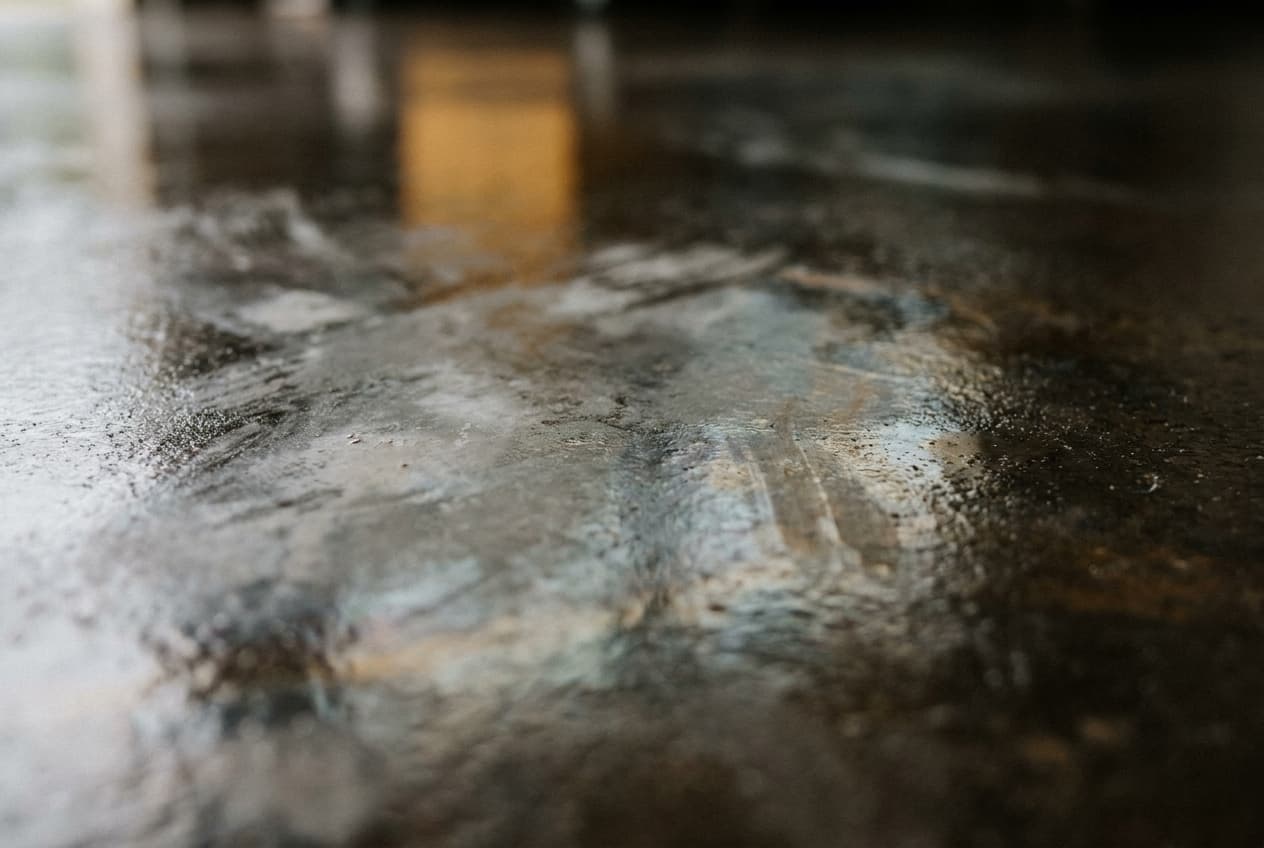
A cloudy, oily, or hazy surface on a freshly cured epoxy floor is amine blush — also called carbamation or amine bloom. The amine curing agent in the epoxy reacts with moisture and carbon dioxide in the air while the coating is still curing. That reaction pushes a waxy, water-soluble film to the surface.
It is a cure-condition failure, not a product defect. The same kit, mixed the same way, cures perfectly clear when the air is dry and the slab is warm enough — and blushes when it is humid, cold, or the slab surface drops near the dew point overnight. The mix didn't fail. The weather did.
What it looks like
Amine blush shows up in a few recognisable ways:
- A milky, cloudy or hazy cast over an otherwise glossy floor
- A greasy or oily film you can wipe and partly remove
- A sticky or tacky surface that won't fully harden
- Poor gloss, or a second coat that fish-eyes and won't bond
The real cause: the slab was too close to the dew point
Blush is a humidity-and-temperature problem, and the single most-missed driver is the dew-point spread — the gap between the slab's surface temperature and the dew point of the air around it.
Concrete is a heat sink. A slab can sit 5–10°F colder than the air for hours, especially in a garage or basement in spring and fall. When the cold slab surface drifts within about 5°F of the dew point, moisture starts condensing into the curing film — invisibly — and the amine reaction runs away. Crucially, air temperature alone won't warn you: the air can read a comfortable 65°F while the slab sits at 54°F against a 50°F dew point.
That is why the industry rule is written about the surface, not the air: keep the slab surface at least 5°F above the dew point through the entire cure, not just at mix time. Most blushed floors were coated late in the day, when the slab was already shedding heat toward an overnight dew point nobody had looked up.
- Slab surface temp at least 5°F above the dew point — through cure, not just application
- Relative humidity under ~80% for the first several hours
- Slab and air both in the 50–86°F band (polyaspartics tolerate a wider range)
- No falling-temperature window that drives the slab toward the dew point overnight
Can you fix a floor that already blushed?
Sometimes. Because the blush film is water-soluble, a light bloom can often be removed before you recoat: scrub the surface with warm water and a mild detergent (or the manufacturer's recommended cleaner), rinse, and let it dry fully. Wipe a hidden patch first to confirm the haze lifts.
If the floor is still tacky, deeply hazed, or the blush has interfered with through-cure, washing won't save it — you're into mechanical abrasion: sand or diamond-grind back to a sound, dull profile, vacuum, and recoat under correct conditions. Either way, do not topcoat over active blush — the contamination wrecks adhesion and the next coat fails too.
How to make sure it never happens again
Blush is almost entirely preventable once you stop coating to the air temperature and start coating to the dew-point spread. Check the slab surface temperature with an IR thermometer, pull the dew point for your location, and confirm you have margin that holds through the cure window — including overnight.
That overnight forecast is exactly what paint-day watches. The free epoxy city pages show a 7-day go/no-go calendar built from the surface-vs-dew-point rule, and the free job-site monitor emails you when a coating window opens — or when overnight condensation risk threatens a floor that's still curing.
Common questions
- What is amine blush on an epoxy floor?
- Amine blush is a cloudy, greasy or hazy film that forms when the amine curing agent in epoxy reacts with moisture and carbon dioxide in the air during cure. It is a curing-condition problem caused by high humidity, low temperature, or the slab surface sitting too close to the dew point — not a defective product.
- Can amine blush be removed?
- Light blush is water-soluble and can often be scrubbed off with warm water and a mild detergent, then rinsed and dried before recoating. Heavy blush, or a floor that stayed tacky, usually has to be sanded or diamond-ground back to a sound profile and recoated under correct conditions. Never topcoat over active blush.
- What humidity is too high for epoxy?
- Most epoxy manufacturers want relative humidity under about 80% for the first several hours of cure, and the slab surface temperature at least 5°F above the dew point. The slab — not the air — is what matters, because concrete runs colder than the air and can drift toward the dew point overnight.
- Why does my epoxy floor feel greasy or sticky?
- A greasy or sticky surface on a cured epoxy floor is the classic sign of amine blush: the curing reaction was disrupted by moisture, leaving a waxy, water-soluble film and an incomplete cure. It points to humidity, cold, or a dew-point-close slab during application.
Check your week
Live epoxy & resin floors forecasts
See a 7-day go/no-go calendar built from the surface-vs-dew-point rule for your city.
More from the field guide
- Dew point for painting: the rule that prevents most coating failures
- Can you paint when it's humid? Yes — but watch the right number
- Why is my deck stain still tacky and won't dry?
- How long does deck stain need to dry before rain?
- Why is my epoxy floor still soft, tacky or not curing?
- How to tell if your concrete slab is dry enough to coat
Last reviewed 2026-06-29. A scheduling & risk advisory — confirm the surface temperature on-site with an IR thermometer before you coat.